
 Academia Sinica
 Research Brochure
 ASIAA Login

Instrumentation Research
![[previous]](../_img/_icon4gallery/prev.gif)
![[pause]](../_img/_icon4gallery/pause.gif)
![[next]](../_img/_icon4gallery/next.gif)
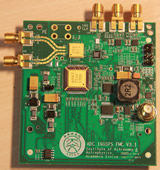
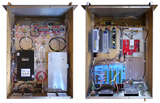
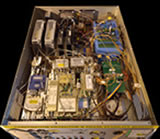
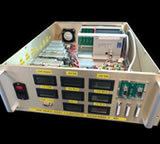
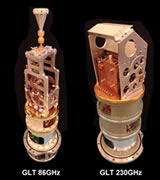
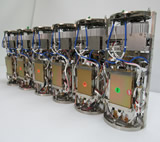
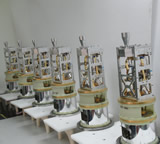
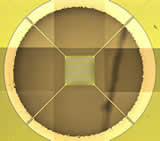
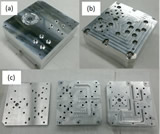
![The Tomographic Ionized-carbon Mapping Experiment (TIME) adopted a grating type spectrometer to achieve instantaneous wideband spectral coverage with background-limited sensitivity. A unique approach uses curved gratings in parallel-plate waveguides to focus and diffract broadband light from feedhorns to detector arrays. TIME will measure 3-D [CII] fluctuations from 5 < z < 9 galaxies by using 32 independent spectrometers. Each grating has 190 facets and provides a resolving power of 140 over 183–326 GHz range.](../gallery/_img/2017_Instrumentation_S_20170927121651.png)
ASIAA has always focused on developing forefront technology programs which will drive the next generation of instruments. In our first decade, ASIAA concentrated on establishing a strong research program in radio astronomy. The assembly of a strong team which can develope its expertise in millimeter and submillimeter wavelength technologies has been the driver for the Submillimeter Array (SMA), the Y.T. Lee Array (YTLA, formerly AMiBA), and the Atacama Large Millimeter/submillimeter Array (ALMA) programs. The technical group now has a broad range of capabilities, including superconductor-insulator-superconductor mixers and Superconducting Quantum Interference Device (SQUID) chips, Monolithic Microwave Integrated Circuit (MMIC) devices, IF electronics, cryogenics, correlator, submillimeter wavelength antennas, carbon fiber reflectors, and control software.
In our second decade, ASIAA began to develop a technical group in optical/infrared (OIR) wavelengths. This assembled team has been the driver for the TAOS and CFHT/WIRCam programs. The success of WIRCam collaboration brought the experience of array testing and control electronics to the core expertise of the OIR laboratory. With such expertise, we continue to work on advanced instrumentation project in large telescopes, such as Spectropolarimètre Infra-Rouge (SPIROU) of CFHT and Hyper SuprimeCam (HSC) and Prime Focus Spectrograph (PFS) of Subaru telescope. Negotiation with Japanese space agency JAXA to join the next generation infrared satellite project Space Infrared telescope for Cosmology and Astrophysics (SPICA) is ongoing. In addition, working on the future thirty-meter class telescope instruments is also planned.
The research of instrumentation in ASIAA includes receiver technology development, microwave device design and assembly, superconducting device development, and OIR detector array development. ASIAA will continue to expand on its technical development groups, with the goal of increasing capabilities in detection sensitivity in various domains.
Research Members (16)
 Deputy Director for Hawaii Operations; Research Fellow
Research Fellow
Associate Research Fellow
Senior Research Engineer
Senior Research Engineer
Senior Research Engineer
Associate Research Engineer
Assistant Research Engineer
Visiting Scholar (Dept. Electrical Engineering, YZ Univ.)
Senior Project engineer
PFS System Engineer
Support Scientist
RCUH Research Fellow / ASIAA Research Scientist
Deputy Director for Hawaii Operations; Research Fellow
Research Fellow
Associate Research Fellow
Senior Research Engineer
Senior Research Engineer
Senior Research Engineer
Associate Research Engineer
Assistant Research Engineer
Visiting Scholar (Dept. Electrical Engineering, YZ Univ.)
Senior Project engineer
PFS System Engineer
Support Scientist
RCUH Research Fellow / ASIAA Research Scientist
Journal Papers (220)
- Chen M-T; Asada K; Matsushita S; Raffin P; Inoue M; Ho PTP; Han C-C; Kubo D; Norton T; Patel NA; Nystrom G; Huang C-WL; Martin-Cocher P; Koay JY; Romero-Cañizales C; Liu C-T; Huang T; Liu K-Y; Wei T; Chang S-H; Chilson R; Oshiro P; Jiang H; Li C-T; Bower G; Shaw P; Nishioka H; Koch PM; Chen C-C; Srinivasan R; Rao R; Snow W; Jinchi H; Han K-C; Chang S-C; Lu L-M; Ogawa H; Kimura K; Hasegawa Y; Pu H-Y; Koyama S; Nakamura M; Bintley D; Walther C; Friberg P; Dempsey J; Sriharan TK; Srikanth S; Doeleman SS; Brissenden R; Algaba Marcos J-C; Jeter B; Kuo C-Y; Park J, "The Greenland Telescope-Construction, Commissioning, and Operations in Pituffik" , PASP: 135 (1051), id.095001 (25 pp), Sep, 2023 [SCI] ( ADS | Fulltext )
- Chang H-W; Ranganayakulu VK; Guan S-Y; Chen P-J; Ou M-N; Chen Y-Y; Chuang T-M; Chang C-S; Wu M-K; Wang MJ, "Dense rotational twins in superconducting (111)–orientated δ–NbN epitaxial films on 4H–SiC substrates" , Supercond Sci Tech: 34(4), id.045019 (9pp), Mar, 2021 [SCI] ( ADS | Fulltext )
- Wang C-L; Chiu C-P; Huang P-J; Wang S-Y; Wang M-J, "High-performance 1–10 THz integrating sphere" , Applied Optics: 60(13), p.3784, May, 2021 [SCI] ( ADS | Fulltext )
- Jiang H; Yu C-Y; Chen M; et al., "A Low Cost 4 bit 16 Giga-sample-per-second Analog-to-digital Converter for Radio Astronomy" , PASP: 132(1014), id.085001 (7pp.), Aug, 2020 [SCI] ( ADS | Fulltext )
- Wu YC; Chiong CC; Hwang YJ; et al., "An Innovative Joint-Injection Mixer with Broadband IF and RF for Advanced Heterodyne Receivers of Millimeter-wave Astronomy" , IEEE T Microw Theory: 68(12), 5408-5422, Dec, 2020 [SCI] ( ADS | Fulltext )
- Chang HW; Wang CL; Huang YR; Chen TJ; Wang MJ, "Growth and characterization of few unit-cell NbN superconducting films on 3C-SiC/Si substrate" , Supercond Sci Tech: 30, 115010, Nov, 2017 [SCI] ( ADS | Fulltext )
- Hsu WC; Ling HS; Wang SY; Lee CP, "Characteristics of surface plasmon coupled quantum well infrared photodetectors" , J Appl Phys: 121(24), 244503, June 28, 2017 [SCI] ( ADS | Fulltext )
- Matsushita S; Asada K; Martin-Cocher PL; Chen M-T; Ho PTP; Inoue M; Koch PM; Paine SN; Turner DD, "3.5 Year Monitoring of 225 GHz Opacity at the Summit of Greenland" , PASP: 129(972), 025001, Feb, 2017 [SCI] ( ADS | Fulltext )
- Matsushita S; Asaki Y; Fomalont EB; et al., "ALMA Long Baseline Campaigns: Phase Characteristics of Atmosphere at Long Baselines in the Millimeter and Submillimeter Wavelengths" , PASP: 129(973), 035004, March, 2017 [SCI] ( ADS | Fulltext )
- Morata O; Huang Ted, "ALMA's long look" , Nature Astronomy: 1, 0156, June, 2017 [SCI] ( ADS | Fulltext )
- Hirashita H; Koch PM; Matsushita S; Takakuwa S; Nakamura M; Asada K; Liu HB; Urata U; Wang M-J; Wang W-H; Takahashi S; Tang Y-W; Chang H-H; Huang K; Morata O; Otsuka M; Lin K-Y; Tsai A-L; Lin Y-T; Srinivasan S; Martin-Cocher P; Pu J-Y; Kemper F; Patel N; Grimes P; Huang Y-D; Han C-C; Huang Y-R; Nishioka H; Lin C-CL; Zhang Q; Keto E; Burgos R; Chen M-T; Inoue M; Ho PTP, "First-generation Science Cases for Ground-based Terahertz Telescopes" , PASJ: 68(1), R1, Feb, 2016 [SCI] ( ADS | Fulltext )
- Jiang H; Yu C-Y; Kubo D; Chen M-T; et al., "A Low-cost 4 Bit, 10 Giga-samples-per-second Analog-to-digital Converter Printed Circuit Board Assembly for FPGA-based Backends" , PASP: 128(969), 115002, Nov, 2016 [SCI] ( ADS | Fulltext )
- Lin K-Y; Nishioka H; Wang F-C; Huang C-W L; Liao Y-W; Wu J-H P; Koch PM; Umetsu K; Chen MT; ...; Chang S-H; Hoang Ngoc Duy; Han C-C; ...; Ho PTP; Huang Y-D; Jiang H; Li C-T;...; Martin-Cocher P; Molnar SM; et al., "AMiBA: Cluster Sunyaev-Zel'dovich Effect Observations with the Expanded 13-Element Array" , ApJ: 830(2), 91, Oct, 2016 [SCI] ( ADS | Fulltext )
- Chang HH; Chang CC; Chiang YY; ...;Wang MJ; Wu MK, "Growth and Characterization of Superconducting β-FeSe type Iron Chalcogenide Nanowires" , Supercond Sci Tech: 27, 025015, Feb, 2014 [SCI] ( ADS | Fulltext )
- Inoue M; Algaba-Marcos JC; Asada K; Chang C-C; Chen M-T; Han J; Hirashita H; Ho PTP; Hsieh S-N; Huang T; Jiang H; Koch PM; Kubo DY; Kuo C-Y; Liu B; Martin-Cocher P; Matsushita S; Meyer-Zhao Z; Nakamura M; Nishioka H; Nystrom G; Pradel N; Pu H-Y; Raffin PA; Shen H-Y; Snow W; Srinivasan R; Wei T-S; Blundell R; Burgos R; Grimes P; Keto E; Paine S; Patel N; Sridharan TK; Doeleman SS; Fish V; Brisken W; Napier P, "Greenland telescope project: Direct confirmation of black hole with sub-millimeter VLBI" , Radio Science: 49(7), 564-571, July, 2014 [SCI] ( ADS | Fulltext )
- Jiang H; Liu H; Guzzino K; Kubo D; Li CT; Chang R; Chen MT, "A 5 Giga Samples Per Second 8-Bit Analog to Digital Printed Circuit Board for Radio Astronomy" , PASP: 126(942), 761-768, Aug, 2014 [SCI] ( ADS | Fulltext )
- Wang M-J; Wang J-W; Wang C-L; Chiang Y-Y; Chang H-H, "Graphene-based Terahertz Photodetector by Noise Thermometry Technique" , Appl Phys Lett: 104, 033502, Jan, 2014 [SCI] ( ADS | Fulltext )
- Yeh H-C; Chiong C-C; Chen M-T; Wang H, "Advances in Silicon Based Millimeter-Wave Monolithic Integrated Circuits" , Micromachines: 5(4), 1373-1415, Dec, 2014 [SCI] ( ADS | Fulltext )
- Yeh H-C; Chiong C-C; Chen M-T; Wang H, "Review of Millimeter-Wave MMIC Mixers" , IEEE Design & Test: 31(6), 38-45, Nov-Dec, 2014 [SCI] ( ADS | Fulltext )
- Kubo DY; Srinivasan R; Kiuchi H;Chen M-T, "Development of a Mach-Zehnder Modulator Photonic Local Oscillator Source" , IEEE T Microw Theory: 61(8), 3005-3014, Aug, 2013 [SCI] ( ADS | Fulltext )
- Liao Y-W; Lin K-Y; Huang Y-D; Wu JHP; Ho PTP; Chen M-T; Huang CWL; Koch PM; Nishioka H; Cheng T-A; Fu S-Y; Liu G-C; Molnar SM; Umetsu K; Wang F-C; Chang Y-Y; Han C-C; Li C-T; Martin-Cocher P; Oshiro P, "Platform Deformation Phase Correction for the AMiBA-13 Coplanar Interferometer" , ApJ: 769(1), 71, May, 2013 [SCI] ( ADS | Fulltext )
- Liu K-Y; Wang MJ; Li C-T; Chen T-J; Shi S-C, "Development of a Dual Polarization SIS Mixer with a Planar Orthomode Transducer at 350 GHz" , IEEE T Appl Supercon: 23(3), 1400705, June, 2013 [SCI] ( ADS | Fulltext )
- Chang HH; Luo JY; Wu CT; Hsu FC; Huang TW; Wu PM; Wu MK; Wang MJ, "Weak localization in FeSe1-xTex superconducting thin films" , Supercond Sci Tech: 25(3), 035004, March, 2012 [SCI] ( ADS | Fulltext )
- Ling HS; Wang SY*; Hsu WC; Lee CP, "Voltage-tunable dual-band quantum dot infrared photodetectors for temperature sensing" , Opt Express: 20(10), 10484-10489, May 7, 2012 [SCI] ( ADS | Fulltext )
- Liu M-C; Chaussidon M; Göpel C; Lee T, "A Heterogeneous Solar Nebula as Sampled by CM Hibonite Grains" , Earth Planet Sc Lett: 327-238, 75-83, April, 2012 [SCI] ( ADS | Fulltext )
- Chang HH; ...; Hsu FC; ...; Wang M-J, "The vortex state of FeSe1 - xTex superconducting thin films" , Supercond Sci Tech: 24, 105011, Oct, 2011 [SCI] ( ADS | Fulltext )
- Huang Y-D; Raffin P; Chen MT, "Stiffness study of a hexapod telescope platform" , IEEE T Antenn Propag: 59(6), 2022-2028, June, 2011 [SCI] ( ADS | Fulltext )
- Koch PM; Raffin P; Huang Y-D; Chen M-T; Han C-C; Lin K-Y; Altamirano P; ...; Ho PTP; ...; Li C-T; Liao Y-W; Liu G-C; Nishioka H; ...; Oshiro P; Umetsu K; et al., "1.2 m Shielded Cassegrain Antenna for Close-Packed Radio Interferometer" , PASP: 123(900), 198-212, Feb, 2011 [SCI] ( ADS | Fulltext )
- Li C-T; Liu K-Yu; Lu W-C; Chiu C-P; Chen T-J; Chen C-W; Chang Y-C; Wang M-J; Shi S-C, "Development of 460 GHz and Dual Polarization SIS Mixers for the Submillimeter Array" , IEEE T Appl Supercon: 21(3), 654-658, June, 2011 [SCI] ( ADS | Fulltext )
- Liu MC; Chaussidon M; Gopel C; Lee T, "A Heterogeneous Solar Nebula as Sampled by CM Hibonites" , Meteorit Planet Sci: 46(SI), A141, July, 2011 [SCI] ( ADS | Fulltext )
- Wang SY; Ling HS; Lee CP, "Temperature dependence of quantum efficiency in Quantum Dot Infrared Photodetectors" , Infrared Phys Techn: 54(3), 224-227, May, 2011 [SCI] ( ADS | Fulltext )
- Chang HH;...; Hsu FC;...; Wang MJ, "Te substitution effect on electronic properties of beta-FeSe thin films" , Physica C: 470, S480-S481, Dec, 2010 [SCI] ( ADS | Fulltext )
- Li CT; Kubo DY; Wilson W; ...; Lin KY; Chen MT; Ho PTP; Chen CC; Han CC; Oshiro P; Martin-Cocher P; Chang CH; Chang SH; Altamirano P; Jiang H;...; Wang H; ...; Chang SW; Huang YD; Hwang YJ; ...; Koch P; Liu GC; Nishioka H; Umetsu K; Wei T; Wu JHP, "AMiBA Wideband Analog Correlator" , ApJ: 716(1), 746-757, June 10, 2010 [SCI] ( ADS | Fulltext )
- Liu M-C; Nittler LR; O'D Alexander CM; Lee T, "Lithium–Beryllium–Boron Isotopic Compositions in Meteoritic Hibonite: Implications for Origin of 10Be and Early Solar System Irradiation" , ApJ: 719(1), L99-L103, Aug, 2010 [SCI] ( ADS | Fulltext )
- Matsushita S; Chen YL, "Testing the Atacama Compact Array Phase-Correction Scheme Using the Submillimeter Array" , PASJ: 62(4), 1053-1062, Aug 25, 2010 [SCI] ( ADS | Fulltext )
- Takami M; Tamura M; Enya K; et al., "Studies of expolanets and solar systems with SPICA" , Adv Space Res: 45(8), 1000-1006, Apr, 2010 [SCI] ( ADS | Fulltext )
- Ho PTP; Altamirano P; Chang C-H; Chang S-H; Chang S-W; Chen C-C; Chen K-J; Chen M-T; Han C-C; Ho WM; Huang Y-D; Hwang Y-J; Ibañez-Romano F; Jiang H; Koch PM; Kubo DY; Li C-T; Lim J; Lin K-Y; Liu G-C; Lo K-Y; Ma C-J; Martin RN; Martin-Cocher P; Molnar SM; Ng K-W; Nishioka H; O'Connell KE; Oshiro P; Patt F; Raffin P; Umetsu K; Wei T; et al., "The Yuan-Tseh Lee Array for Microwave Background Anisotropy" , ApJ: 694(2), 1610-1618, April 1, 2009 [SCI] ( ADS | Fulltext )
- Koch PM; Kesteven M; Nishioka H; Jiang H; Lin K-Y; Umetsu K; Huang Y-D; Raffin P; Chen K-J; Ibañez-Romano F; Chereau G; Huang C-WL; Chen M-T; Ho PTP; Pausch K; Willmeroth K; Altamirano P; Chang C-H; Chang S-H; Chang S-W; Han C-C; Kubo D; Li C-T; Liao Y-W; Liu G-C; Martin-Cocher P; Oshiro P; Wang F-C; Wei T-S; Wu J-HP; Birkinshaw M; Chiueh T; Lancaster K; Lo KY; Martin RN; Molnar SM; et al., "The AMiBA Hexapod Telescope Mount" , ApJ: 694(2), 1670-1684, April 1, 2009 [SCI] ( ADS | Fulltext )
- Lehner MJ; Wen C-Y; Wang J-H; ...; King S-K; et al., "The Taiwanese-American Occultation Survey: The Multi-Telescope Robotic Observatory" , PASP: 121(876), 138-152, Feb 2009, 2009 [SCI] ( ADS | Fulltext )
- Lin K-Y; Li C-T; Ho PTP; Huang C-WL; Liao Y-W; Liu G-C; Koch PM; Molnar SM; Nishioka H; Umetsu K; Wang F-C; Wu J-HP; Kestevan M; Birkinshaw M; Altamirano P; Chang C-H; Chang S-H; Chang S-W; Chen M-T; Martin-Cocher P; Han C-C; Huang Y-D; Hwang Y-J; Ibañez-Roman F; Jiang H; Kubo DY; Oshiro P; Raffin P; Wei T; Wilson W; Chen K-J; Chiueh T, "AMiBA: System Performance" , ApJ: 694(2), 1629-1636, Apr 1, 2009 [SCI] ( ADS | Fulltext )
- Ling HS; Wang SY; Lee CP; Lo MC, "Confinement Enhanced Dots-in-a-well Quantum Dot Infrared Photodetectors with Operating Temperatures over 200K" , Infrared Phys Techn: 52(6), 281-284, Nov, 2009 [SCI] ( ADS | Fulltext )
- Nishioka H; Wang F-C; Wu J-HP; Ho PTP; Huang C-WL; Koch PM; Liao Y-W; Lin K-Y; Liu G-C; Molnar SM; Umetsu K; Birkinshaw M; Altamirano P; Chang C-H; Chang S-H; Chang S-W; Chen M-T; Han C-C; Huang Y-D; Hwang Y-J; Jiang H; Kesteven M; Kubo DY; Li C-T; Martin-Cocher P; Oshiro P; Raffin P; Wei T; Wilson W, "Tests of AMiBA Data Integrity" , ApJ: 694(2), 1637-1642, Apr 1, 2009 [SCI] ( ADS | Fulltext )
- Wang MJ; Luo JY; Huang TW; Chang HH; et al., "Crystal orientation and thickness dependence of superconductivity on tetragonal FeSe1-x thin films" , Phys Rev Lett: 103(11), Art. No. 117002, Sept 11, 2009 [SCI] ( ADS | Fulltext )
- Wang SY; Ling HS; Lo MC; Lee CP, "Detection Wavelength and Device Performance Tuning of InAs QDIPs with thin AlGaAs layers" , Infrared Phys Techn: 52(6), 264-267, Nov, 2009 [SCI] ( ADS | Fulltext )
- Ho PTP; Altimirano P; Birkinshaw M; Chang SW; Chang CH; Chen KJ; Chen M; Chiueh TD; Chiueh T; Chu TH; Han CC; Huang CW; Huang YD; Hwang WYP; Hwang YJ; Jiang H; Kesteven M; Koch P; Kubo D; Lancaster K; Li CT; Liang H; Liao YW; Lim J; Lin YS; Lin KY; Liu GC; Lo KY; Ma CJ; Martin-Cocher P; Martin RN; Molnar S; Ng KW; Nishioka H; Park CG; Patt F; Peterson JB; Raffin P; Romano F; Wang H; Umetsu K; Wang FC; Wu JHP, "The Yuan Tseh Lee AMiBA Project" , MPLA: 23(20), 1243-1251, June, 2008 [SCI] ( ADS | Fulltext )
- Huang PC; Tsai MD; Vendelin GD; et al., "A low-power 114-GHz push-push CMOS VCO using LC source degeneration" , IEEE J Solid-State Circuits: 42(6), 1230-1239, Jun, 2007 [SCI] ( ADS | Fulltext )
- Hwang Y-J; Rao R; Christensen R; Chen M-T; Chu T-H, "Submillimeter-Wave Phasor Beam-Pattern Measurement Based on Two-Stage Heterodyne Mixing With Unitary Harmonic Difference" , IEEE T Microw Theory: 55(6), 1200-1208, Jun, 2007 [SCI] ( ADS | Fulltext )
- Wang MJ; Suen NT; Ho JY; Sheu HS; Chong HH; Lin HY; Tang HY, "Synthesis and Structure Transformation of Ion-Exchanged Metal Cobalt Oxides" , Crys Growth Des: 7(12), 2738-2741, Dec, 2007 [SCI] ( ADS | Fulltext )
- Wang SY; Lo MC; Hsiao HY; et al., "Temperature dependent responsivity of quantum dot infrared photodetectors" , Infrared Phys Techn: 50(2-3), 166-170, Apr, 2007 [SCI] ( ADS | Fulltext )
- Ho PTP; Chen M-T; ...; Chiueh T; Chu T-H; Jiang H; Koch P; Kubo D; Li C-T; ...; Lin K-Y; Liu G-C; Lo K-Y; Ma C-J; Martin RN; Ng K-W; Nishioka H; Patt F; ...; Wang H; Hwang Y-J; Umetsu K; et al., "The AMiBA Project" , MPLA: 19(13-16), 993-1000, May 30, 2004 [SCI] ( ADS | Fulltext )
- Ho PTP; Moran JM; Lo KY, "The Submillimeter Array" , ApJ: 616(1), L1-L6, Nov 20, 2004 [SCI] ( ADS | Fulltext )
- Hu R; Weinreb S, "A Novel Wide-baud Noise Parameter Measurement Method and its Cryogenic Application" , IEEE T Microw Theory: 52(5), 1498-1507, May, 2004 [SCI] ( ADS | Fulltext )
- Hwang Y-J; Wang H; Chu T-H, "A W-band Subharmonically Pumped Monolithic GaAs-Based HEMT Gate Mixer" , IEEE Microw Wirel Co: 14(7), 313-315, Jul, 2004 [SCI] ( ADS | Fulltext )
- Su Y-N; Liu SY; Lim J; Ohashi N; ...; Ho PTP, "Search for Calibrators for the Submillimeter Array.I. High-Mass Star-forming Regions" , ApJ: 616(1), L39-L42, Nov 20, 2004 [SCI] ( ADS | Fulltext )
- Cheng HW; Chi CC, "The anomaly of zero-bias conductance peak of the tunnelling spectroscopy on the a-axis oriented YBa2Cu3Oy epitaxial films" , J Low Temp Phys: 131(3-4), 477-481, May, 2003 [SCI] ( ADS | Fulltext )
- Wang MJ; Cheng HW; Wu SL; et al, "New thickness control process of oxide barrier for Nb-based tunnel junctions" , IEEE T Appl Supercon: 13(2), 1100-1103, Jun, 2003 [SCI] ( ADS | Fulltext )
- Wang SY; Chen SC; Lin SD; et al, "InAs/GaAs quantum dot infrared photodetectors with different growth temperatures" , Infrared Phys Techn: 44(5-6), 527-532, Oct-Dec, 2003 [SCI] ( ADS | Fulltext )
- Chin CC; Wang MJ; Shah WL; Zhang W; Cheng HW; et al, "A fixed tuned low noise 600-700 GHz SIS receiver" , Int J Infrared Milli: 23(5), 731-744, May, 2002 [SCI] ( ADS | Fulltext )
- Hwang YJ; Lien CH; Wang H; ...; Chu TH, "A 78-114 GHz monolithic subharmonically pumped GaAs-based HEMT diode mixer" , IEEE Microw Wirel Co: 12(6), 209-211, 2002 [SCI] ( ADS | Fulltext )
- Wang MJ; Chuang PK; Wu SL; Cheng H-W; Chi CC, "New barrier materials for ultrahigh current-density Josephson tunnel junction" , Singapore Journal of Physics: 18, 221-226, July, 2002 ( ADS | Fulltext )
- Wang MJ; Cheng HW; Ho YH; Chin CC; Chi CC, "Low noise Nb-based SIS mixer for sub-millimeter wave detection" , J Phys Chem Solids: 62(9-10), 1731-1736, Sep-Oct, 2001 [SCI] ( ADS | Fulltext )
- Wang SY; Chin YC; Lee CP, "A detailed study of non-uniform quantum well infrared photodetectors" , Infrared Phys Techn: 42(3-5), 177-184, Jun-Oct, 2001 [SCI] ( ADS | Fulltext )
- Wang SY; Lin SD; Wu HW; Lee CP, "Low dark current quantum-dot infrared photodetectors with an AlGaAs current blocking layer" , Appl Phys Lett: 78(8), 1023-1025, Feb 19, 2001 [SCI] ( ADS | Fulltext )
- Wang SY; Lin SD; Wu HW; Lee CP, "High performance InAs/GaAs quantum dot infrared photodetectors with AlGaAs current blocking layer" , Infrared Phys Techn: 42(3-5), 473-477, Jun-Oct, 2001 [SCI] ( ADS | Fulltext )
- Yang SC; Chin CC; Hu R; Shen SS, "A 200 GHz near field measurement system" , Rev Sci Instrum: 70(5), 2526-2532, May, 1999 [SCI] ( ADS | Fulltext )
- Chin CC, "A novel sensitive method of surface impedance measurement for small samples" , Rev Sci Instrum: 69(2), 469-473, Feb, 1998 [SCI] ( ADS | Fulltext )
- Chin CC; Hu R; Martin R, "The superconducting receivers of the Sub-mm array of Taiwan" , Chinese J Phys: 36(2), 416-419, Apr, 1998 [SCI] ( ADS | Fulltext )
- Chen MT; Tong CYE; Paine S; Blundell R, "Characterization of corrugated feed horns at 216 and 300 GHz" , Int J Infrared Milli: 18(9), 1697-1711, Sep, 1997 [SCI] ( ADS | Fulltext )
- Chin CC; Lin RJ; Yu YC; et al, "Resonant rutherford backscattering studies of cerium oxide thin films deposited by RF sputtering" , IEEE T Appl Supercon: 7(2), 1403-1406, Jun, 1997 [SCI] ( ADS | Fulltext )
- Chin CC; Lin RJ; Yu YC; et al, "On the off stoichiometry of cerium oxide thin films deposited by RF sputtering" , Physica C: 260(1-2), 86-92, Apr 1, 1996 [SCI] ( ADS | Fulltext )
- Li D; Jone WB, "Pseudorandom test-length analysis using differential solutions" , IEEE T Comput Aid D: 15(7), 815-825, 1996 [SCI] ( ADS | Fulltext )
- Huang TW; Chuang KJ; Bai WT; Wang CW; Lin WJ; Zhong JY; Chien C; Tsai JH, "A 28-nm CMOS Sub-Volt PA with High Power Density and Common-Mode Stability Design" , IEEE Microwave and Wireless Technology Letters: 33(7), 1019 - 1022, July, 2023 [SCI] ( ADS | Fulltext )
- Nanjo S; Ebukuro S; Nakamura S; Miyoshi Y; Kurita S; Oyama SI; Ogawa Y; Keika K; Kasahara Y; Kasahara S; Matsuoka A; Hori T; Yokota S; Matsuda S; Shinohara I; Wang SY; Kazama Y; Jun CW; Kitahara M; Hosokawa K, "An Implication of Detecting the Internal Modulation in a Pulsating Aurora: A Conjugate Observation by the Arase Satellite and All-Sky Imagers" , J Geophys Res Space Phys: 128(8), e2023JA031499, Aug, 2023 [SCI] ( ADS | Fulltext )
- Wang Y; Chiu T-Y; Chiu T-Y; Yu K-J; Teng Y-M; Huang G-W; Li C-H; Kuo C-N; Chiong C-C; Wang H, "A K-a-to G-Band Detector With 5.5-GHz Video Bandwidth Using a Modified Traveling-Wave Structure in 65-nm CMOS Technology" , IEEE Trans. Circuits Syst. II-Express Briefs: 70(4), 1371-1375, April, 2023 [SCI] ( ADS | Fulltext )
- Chiu F-Y; Hung T-L; Liu C-Y; Pai Y-H; Chien W-L; Chen P-J; Lee T-K; Wang M-J; Ou M-N; Tsuei CC; Wu M-K; Chang C-S; Chen Y-Y, "Absence of superconductivity in micrometer-sized ɛ -NbN single crystals" , Phys Rev B: 105(17), id.174512, May, 2022 [SCI] ( ADS | Fulltext )
- Gantepogu CS; Yang C-M; Ganesan P; Chen I-G; Wang M-J; MacManus-Driscoll J; Moon S-H; Wang C; Wu M-K, "Improvement of the value and anisotropy of critical current density in GdBa2Cu3O7-delta coated conductors with self-assembled 3-dimensional BaZrO3 nanostructure" , Materials Today Physics: 20, id.100455, Sep, 2021 [SCI] ( ADS | Fulltext )
- Kamp I; Honda M; Nomura H; Audard M; Fedele D; Waters LBFM; Aikawa Y; Banzatti A; Bowey JE; Bradford M; Dominik C; Furuya K; Habart E; Ishihara D; Johnstone D; Kennedy G; Kim M; Kral Q; Lai SP; Larsson B; Mcclure M; Miotello A; Momose M; Nakagawa T; Naylor D; Nisini B; Notsu S; Onaka T; Pantin E; Podio L; Riviere Marichalar P; Rocha WRM; Roelfsema P; Santos F; Shimonishi T; Tang YW; Takami M; Tazaki R; Wolf S; Wyatt M; Ysard N, "The formation of planetary systems with SPICA" , PASA: 38, id. e055, Nov, 2021 [SCI] ( ADS | Fulltext )
- Mizuno I; Han C-C, "JCMT opens new eyes on the Universe" , Nature Astronomy: 5, 331–332, Mar, 2021 [SCI] ( ADS | Fulltext )
- Chao DCY; Chan JHH; Suyu SH; et al., "Lensed quasar search via time variability with the HSC transient survey" , A&A: 640, id. A88 (17pp.), Aug, 2020 [SCI] ( ADS | Fulltext )
- Donati JF; Kouach D; Moutou C; ...; Wang SY; ...; Yan CH; et al., "SPIRou: NIR velocimetry and spectropolarimetry at the CFHT" , MNRAS: 498(4), 5684-5703, Aug, 2020 [SCI] ( ADS | Fulltext )
- Inaba Y; Shiokawa K; Oyama S-I; ...; Kazama Y; Wang S-Y; ...; Wang B-J; et al., "Plasma and Field Observations in the Magnetospheric Source Region of a Stable Auroral Red (SAR) Arc by the Arase Satellite on 28 March 2017" , J Geophys Res Space Phys: 125(10), id.e28068 (18pp.), Oct, 2020 [SCI] ( ADS | Fulltext )
- Lu B-Z; Wang YS; Wu Y-C; Chiong CC; et al., "A Submilliwatt K-Band Low-Noise Amplifier for Next Generation Radio Astronomical Receivers in 65-nm CMOS Process" , IEEE Microw Wirel Co: 30(7), 669-672, Jul, 2020 [SCI] ( ADS | Fulltext )
- Maud LT; Asaki Y; Fomalont EB; ...; Matsushita S; et al., "ALMA High-frequency Long-baseline Campaign in 2017: A Comparison of the Band-to-band and In-band Phase Calibration Techniques and Phase-calibrator Separation Angles" , ApJS: 250(1), id.18 (26pp.), Sep, 2020 [SCI] ( ADS | Fulltext )
- Yagoubov P; Mroczkowski T; Belitsky V; ...; Kemper F; et al., "Wideband 67-116 GHz receiver development for ALMA Band 2" , A&A: 634, id.A46 (23 pp.), Feb, 2020 [SCI] ( ADS | Fulltext )
- Yeh K-Y; Chen Y-R; Lo T-S; ...; Wang M-J; et al., "Fe-vacancy Ordered Fe 4 Se 5 -The Insulating Parent Phase of FeSe Superconductor" , Frontiers in Physics: 8, id.505 (20pp), Nov, 2020 [SCI] ( ADS | Fulltext )
- Yeh K-Y; Lo T-S; Wu PM; ...; Wang MJ; et al., "Magnetotransport studies of Fe vacancy-ordered Fe4+δSe5 nanowires" , PNAS: 117(23), 12606-12610, Jun, 2020 [SCI] ( ADS | Fulltext )
- Zeng L; Lu W-C; Grimes PK; Chen T-J; Chang Y-P; …; Wang M-J, "A Silicon Chip-Based Waveguide Directional Coupler for Terahertz Applications" , IEEE Trans THz Sci Technol: 10(6), 698-703, Nov, 2020 [SCI] ( ADS | Fulltext )
- Chandan P; Chang CC; Yeh KW; ...; Wang MJ; et al., "Voltage fade mitigation in the cationic dominant lithium-rich NCM cathode" , Communications Chemistry: 2, id. 120, Oct, 2019 [SCI] ( ADS | Fulltext )
- Chang Y; Wang Y; Chen C-N; Wu Y-C; Wang H, "A V-Band Power Amplifier With 23.7-dBm Output Power, 22.1% PAE, and 29.7-dB Gain in 65-nm CMOS Technology" , IEEE T Microw Theory: 67(11), 4418-4426, Nov, 2019 [SCI] ( ADS | Fulltext )
- Chen Y; Chen C-N; Chiong C-C; Wang H, "A Compact 40-GHz Doherty Power Amplifier With 21% PAE at 6-dB Power Back Off in 0.1- μ m GaAs pHEMT Process" , IEEE Microw Wirel Co: 29(8), 545-547, Aug, 2019 [SCI] ( ADS | Fulltext )
- Event Horizon Telescope Collaboration; Akiyama K; Alberdi A; ...; Asada K; ...; Bower GC; ...; Chen MT; ...; Ho PTP; ...; Huang C-W L; ...; Inoue M; ...; Koay JY; Koch PM; Koyama S; ...; Lo W-P; ...; Matsushita S; ...; Nakamura M; ...; Rao R; ...; Meyer-Zhao Z; ...; Nishioka H; ...; Pradel N; et al., "First M87 Event Horizon Telescope Results. III. Data Processing and Calibration" , ApJL: 875(1), id. L3 (32 pp.), Apr, 2019 [SCI] ( ADS | Fulltext )
- Event Horizon Telescope Collaboration; Akiyama K; Alberdi A; ...; Asada K; ...; Bower GC; ...; Chen MT; ...; Ho PTP; ...; Huang C-W L; ...; Inoue M; ...; Koay JY; Koch PM; Koyama S; ...; Kuo C-Y; ...; Lo W-P; ...; Matsushita S; ...; Nakamura M; ...; Pen U-L; ...; Pu H-Y; ...; Rao R; ...; Algaba J-C; ...; Chang C-C; Chang S-H; Chen C-C; Chilson R; ...; Han C-C; ...; Huang Y-D;...; Jiang H; ...; Kubo D; ...; Li C-T; Lin LC-C; ...; Liu K-Y; ...; Martin-Cocher PL; ...; Meyer-Zhao Z; ...; Nishioka H; ...; Nystrom G; ...; Oshiro P; ...; Pradel N; ...; Raffin PA; ...; Shaw P; ...; Snow W; ...; Srinivasan R; ...; Wei T-S; Yu C-Y; et al., "First M87 Event Horizon Telescope Results. II. Array and Instrumentation" , ApJL: 875(1), id. L2 (28 pp.), Apr, 2019 [SCI] ( ADS | Fulltext )
- Huang C-H; Wang C-W; Chang C-C; ...; Wang M-J; et al., "Anomalous magnetic properties in Mn(Se, S) system" , Journal of Magnetism and Magnetic Materials: 483, 205-211, Aug, 2019 [SCI] ( ADS | Fulltext )
- Zhong JQ; Zhang W; Miao W; ...; Wang MJ; et al., "Fast-Response Superconducting Titanium Bolometric Detectors" , IEEE T Appl Supercon: 29(5), id. 2100205, Aug, 2019 [SCI] ( ADS | Fulltext )
- Hori T; Nishitani N; Shepherd SG; ...; Kazama Y; Wang S-Y; ...; Wang B-J; et al., "Substorm-Associated Ionospheric Flow Fluctuations During the 27 March 2017 Magnetic Storm: SuperDARN-Arase Conjunction" , Geophys Res Lett: 45(18), 9441-9449, Sep, 2018 [SCI] ( ADS | Fulltext )
- Hsiung HI; Chao WH; Hsu HY; Wang MJ; et al., "Observation of iron d-orbitals modifications in superconducting FeSe by Raman spectra study" , Physica C: 552, 61-63, Sep, 2018 [SCI] ( ADS | Fulltext )
- Hsu WC; Ling HS; Wang SY; Lee CP, "Wavelength tuning of surface plasmon coupled quantum well infrared photodetectors" , Opt Express: 26(1), 552-558, Jan, 2018 [SCI] ( ADS | Fulltext )
- Hsu WC; Ling HS; Wang SY; Lee CP, "Dependence of Performance of Surface Plasmon Coupled Quantum Well Infrared Photodetectors on Doping" , JNN: 18(11), 7838-7842, Nov, 2018 [SCI] ( ADS | Fulltext )
- Hu J-H; Choing C-C; Hwang Y-J; Tsai Z-M, "E-Band Mixer With IP1dB Design Consideration for Radio Astronomical Instrumentation" , IEEE Microw Wirel Co: 28(5), 452-454, May, 2018 [SCI] ( ADS | Fulltext )
- Hunacek J; Bock J; Bradford CM; ...; Chang TC; ...; Li CT; et al., "Hafnium Films and Magnetic Shielding for TIME, A mm-Wavelength Spectrometer Array" , J Low Temp Phys: 193(5-6), 893-900, Dec, 2018 [SCI] ( ADS | Fulltext )
- Kawanomoto S; Uraguchi F; Komiyama Y; ...; Wang S-Y; et al., "Hyper Suprime-Cam: Filters" , PASJ: 70(4), id.66, Aug, 2018 [SCI] ( ADS | Fulltext )
- Komiyama Y; Obuchi Y; Nakaya H; ...; Wang S-Y, "Hyper Suprime-Cam: Camera dewar design" , PASJ: 70(SP1), S2, Jan, 2018 [SCI] ( ADS | Fulltext )
- Miyoshi Y; Shinohara I; Takashima T; ...; Wang SY; ...; Ho PTP; et al., "Geospace exploration project ERG" , Earth Planets and Space: 70, 101, June, 2018 [SCI] ( ADS | Fulltext )
- Pokorny M; Law CJ; Bower GC; et al., "Vys: A Protocol for Commensal Fast Transient Searches and Data Processing at the Very Large Array" , JAI: 7(2n03), id. 1850005, 2018 [SCI] ( ADS | Fulltext )
- Roelfsema PR; Shibai H; Armus L; ...; Kemper F; et al., "SPICA-A Large Cryogenic Infrared Space Telescope: Unveiling the Obscured Universe" , PASA: 35, id.e030 (17 pp.), Aug, 2018 [SCI] ( ADS | Fulltext )
- van der Tak FFS; Madden SC; Roelfsema P; ...; Kemper F; et al., "Probing the baryon cycle of galaxies with SPICA mid- and far-infrared observations" , PASA: 35, e002, Jan, 2018 [SCI] ( ADS | Fulltext )
- Wang CH; Chen TK; Chang CC; Lee YC; Wang MJ; Huang KC; Wu PM; Wu MK, "Fe-vacancy and superconductivity in FeSe-based superconductors" , Physica C: 549, 61-65, June, 2018 [SCI] ( ADS | Fulltext )
- Chao WH; Ying CC; Chen HY; ...; Wang MJ; Wu MK, "Growth and superconducting characteristics of novel BiS2-based layered superconductor Bi4O4S3" , Science of Advanced Materials: 9(10), 1780-1784, Oct, 2017 [SCI] ( ADS | Fulltext )
- Garcia EV; Currie T; Guyon O; ...; Takami M; Takato N; et al., "SCExAO and GPI Y JHBand Photometry and Integral Field Spectroscopy of the Young Brown Dwarf Companion to HD 1160" , ApJ: 834(2), 162, Jan, 2017 [SCI] ( ADS | Fulltext )
- Gonzalez A; Tapia V; Finger R; Huang CD; Asayama S; Huang YD, "ALMA Band 1 Optics (35-50 GHz): Tolerance Analysis, Effect of Cryostat Infrared Filters and Cold Beam Measurements" , Journal of Infrared, Millimeter, and Terahertz Wav: 38(10), 1215-1231, Oct, 2017 [SCI] ( ADS | Fulltext )
- Maud LT; Tilanus RPJ; van Kempen TA; ...; Matsushita S, "Phase correction for ALMA. Investigating water vapour radiometer scaling: The long-baseline science verification data case study" , A&A: 605, A121, Sept, 2017 [SCI] ( ADS | Fulltext )
- Yu TY; Chi NC; Tsai HC; Wang SY; et al., "Robust terahertz polarizers with high transmittance at selected frequencies through Si wafer bonding technologies" , Opt Lett: 42(23), 4917-4920, Dec 1, 2017 [SCI] ( ADS | Fulltext )
- Baba S; Nakagawa T; Shirahata M; ...; Ohyama Y; et al., "Revised wavelength and spectral response calibrations for AKARI near-infrared grism spectroscopy: Cryogenic phase" , PASJ: 68(2), 27, April, 2016 [SCI] ( ADS | Fulltext )
- Hickish J; Abdurashidova Z; Ali Z; ...; Jiang H; .. et al., "A Decade of Developing Radio-Astronomy Instrumentation using CASPER Open-Source Technology" , JAI: 5(4), 1641001-12, Dec, 2016 ( ADS | Fulltext )
- Hunacek J; Bock J; Bradford CM; ...; Chang TC; Cheng, YT; ...; Koch P; Li CT; et al., "Design and Fabrication of TES Detector Modules for the TIME-Pilot [CII] Intensity Mapping Experiment" , J Low Temp Phys: 184(3-4), 733-738, Aug, 2016 [SCI] ( ADS | Fulltext )
- Lee SH; Frawley TW; Yao CH; ...; Wang MJ; et al., "Charge and spin coupling in magnetoresistive oxygen-vacancy strontium ferrate SrFeO3–δ" , New Journal of Physics: 18, 093033, Sept 20, 2016 [SCI] ( ADS | Fulltext )
- Primiani RA; Young KH; Young A; ...; Srinivasan R; et al., "SWARM: A 32 GHz Correlator and VLBI Beamformer for the Submillimeter Array" , JAI: 5(4), id. 1641006-810, Dec, 2016 ( ADS | Fulltext )
- Wu Y-C; Chiong C-C; Tsai J-H; Wang H, "A Novel 30-90-GHz Singly Balanced Mixer With Broadband LO/IF" , IEEE T Microw Theory: 64(12), 4611-4623, Dec, 2016 [SCI] ( ADS | Fulltext )
- Zhang W; Zhong JQ; Miao W; ...; Chen TJ; Wang MJ, "Electrical Characteristics of Superconducting Ti Transition Edge Sensors" , J Low Temp Phys: 184(1-2), 11-16, July, 2016 [SCI] ( ADS | Fulltext )
- ALMA Partnership; Brogan CL; Pérez LM; ...; Matsushita S; ...; Takahashi S; Lee C-F; ...; Takakuwa S; ...; Liu H-Y; et al., "The 2014 ALMA Long Baseline Campaign: First Results from High Angular Resolution Observations toward the HL Tau Region" , ApJL: 808(1), L3, July 20, 2015 [SCI] ( ADS | Fulltext )
- ALMA Partnership; Fomalont EB; Vlahakis C; ...; Matsushita S; …; Espada D.; …; Chapillon E; ...; Hasegawa T; ...; Ohashi N; ...; Huang Y-D; Liu S-Y; Kemper F; Koch PM; Chen M-T; ...; Su Y-N; Trejo-Cruz A; Wang K-S; ...; Ho PTP; et al., "The 2014 ALMA Long Baseline Campaign: An Overview" , ApJL: 808(1), L1, July 20, 2015 [SCI] ( ADS | Fulltext )
- ALMA Partnership; Hunter TR; Kneissl R; Matsushita S; et al., "The 2014 ALMA Long Baseline Campaign: Observations of Asteroid 3 Juno at 60 Kilometer Resolution" , ApJL: 808(1), L2, July 20, 2015 [SCI] ( ADS | Fulltext )
- ALMA Partnership; Vlahakis C; Hunter TR; ...; Matsushita S; et al., "The 2014 ALMA Long Baseline Campaign: Observations of the Strongly Lensed Submillimeter Galaxy HATLAS J090311.6+003906 at z = 3.042" , ApJL: 808(1), L4, July 20, 2015 [SCI] ( ADS | Fulltext )
- Chang CC; Chen TK; Lee WC; Lin PH; Wang MJ; et al., "Superconductivity in Fe-chalcogenides" , Physica C: 514, 423-434, July 15, 2015 [SCI] ( ADS | Fulltext )
- Chang HY; Weng RM; Kuo YF, "An independently tunable dual-band bandpass filter using open-loop resonators" , J Electromagnet Wave: 29(1), 1-13, Jan, 2015 [SCI] ( ADS | Fulltext )
- Kataza H; Sakon I; Wada T; ...; Ohyama Y; et al., "Performance Estimation of the Mid-Infrared Camera and Spectrometer Aboard SPICA" , JAI: 4(1-2), id. 1550001, Jun, 2015 ( ADS | Fulltext )
- Lin HT; Wu S-L; Wang J-W; Chen T-J; Wang M-J; et al., "Determination of the London penetration depth of FeSe0.3Te0.7 thin films by scanning SQUID microscope" , Supercond Sci Tech: 28(8), 085006, July 1, 2015 [SCI] ( ADS | Fulltext )
- Sugai H; Tamura N; Karoji H; ...; Ohyama Y; ...; Chang Y-C; Chen H-Y; Chou RCY; ...; Ho PTP; ....; Hsu S-F; Hu Y-S; Huang PJ; ...; Karr JE; ...; Ling H-H; ...; Wang S-Y; Wen C-Y; et al., "Prime Focus Spectrograph for the Subaru telescope: massively multiplexed optical and near-infrared fiber spectrograph" , JATIS: 1(3), 035001, July, 2015 [SCI] ( ADS | Fulltext )
- Wang C-H; Chen T-K; Chang C-C; …; Wang M-J; et al., "Disordered Fe vacancies and superconductivity in potassium- intercalated iron selenide (K2-xFe4+ySe5)" , Europhys Lett: 111(2), 27004, July, 2015 [SCI] ( ADS | Fulltext )
- Wu MK; Wu PM;Wen YC; Wang MJ; et al., "An Overview of the Fe-Chalcogenide Superconductors" , J Phys D: 48(32), 323001, Aug 19, 2015 [SCI] ( ADS | Fulltext )
- Chen T-K; Chang C-C; Chang H-H; ...; Wang M-J; Wu M-K; et al., "Fe-vacancy order and superconductivity in tetragonal β-Fe1-xSe" , PNAS: 111(1), 63-68, Jan, 2014 [SCI] ( ADS | Fulltext )
- Chen T-K; Chang C-C; Tang H-Y; Chang H-H; ...; Wang M-J; Wu M-K; et al., "Structural characteristics and phase separation of superconducting Fe1+ySe1-xTex nanowires" , Materials Research Express: 1, 015026, Feb, 2014 [SCI] ( ADS | Fulltext )
- Han W-Y; ...; Matsumoto T, "MIRIS: A compact Wide-field Infrared Space Telescope" , PASP: 126(943), 853-862, Sept, 2014 [SCI] ( ADS | Fulltext )
- Jeong W-S; Park S-J; Park K; ...; Matsumoto T; et al., "Conceptual Design of the NISS onboard NEXTSat-1" , JASS: 31, 83-90, March, 2014 ( ADS | Fulltext )
- Kao JC; Lin KY; Chiong CC; Peng CY; Wang H, "A W-band High LO-to-RF Isolation Triple Cascode Mixer With Wide IF Bandwidth" , IEEE T Microw Theory: 62(7), 1506-1514, July, 2014 [SCI] ( ADS | Fulltext )
- Kneifel S; Redl S; Orlandi E; ...;Chen MT, "Absorption Properties of Supercooled Liquid Water between 31 and 225 GHz: Evaluation of Absorption Models Using Ground-Based Observations" , J Appl Meteor Climatol: 53(4), 1028-1045, Apr 18, 2014 [SCI] ( ADS | Fulltext )
- Lin K-H; Wang K-J; Chang C-C; ...; Wang M-J; et al., "Observation of pseudogaplike feature above Tc in LiFeAs by ultrafast optical spectroscopy" , Phys Rev B: 90, 174502, Nov 7, 2014 [SCI] ( ADS | Fulltext )
- Mohn J; Wolf B; Toyoda S; Lin CT; Liang MC; et al., "Interlaboratory assessment of nitrous oxide isotopomer analysis by isotope ratio mass spectrometry and laser spectroscopy: current status and perspectives" , Rapid Commun. Mass Spectrom.: 28(18), 1995-2007, Sept 30, 2014 [SCI] ( ADS | Fulltext )
- Tang C-C; Lin H-T; Wu S-L; Chen T-J; Wang M-J; et al., "An interchangeable scanning Hall probe/scanning SQUID microscope" , Rev Sci Instrum: 85, 083707, Aug, 2014 [SCI] ( ADS | Fulltext )
- Bock J; Sullivan I; Arai T; ...; Matsumoto T; et al., "The Cosmic Infrared Background Experiment (CIBER): The Wide-field Imagers" , ApJS: 207(2), 32, Aug, 2013 [SCI] ( ADS | Fulltext )
- Brandt T; McElwain M; Turner E; ...; Takami M, "New Techniques for High-Contrast Imaging with ADI: the ACORNS-ADI SEEDS Data Reduction Pipeline" , ApJ: 764(2), 183, Feb 20, 2013 [SCI] ( ADS | Fulltext )
- Hsu C-H; Chang C-C; Tseng C-M; ...; Wang MJ; et al., "An ultra-fast response gasochromic device for hydrogen gas detection" , Sensors and Actuators B: Chemical: 186, 193-198, June, 2013 [SCI] ( ADS | Fulltext )
- Korngut PM; Renbarger T; Arai T; ...; Matsumoto T; et al., "The Cosmic Infrared Background Experiment (CIBER): The Narrow-Band Spectrometer" , ApJS: 207(2), 34, Aug, 2013 [SCI] ( ADS | Fulltext )
- Lai C-F; Chang C-C; Wang M-J; Wu M-K, "CCT- and CRI-tuning of white light-emitting diodes using three-dimensional non-close-packed colloidal photonic crystals with photonic stopbands" , Opt Express: 21(S4), A687-A694, July, 2013 [SCI] ( ADS | Fulltext )
- Lu R-S; Fish VL; Akiyama K; ...; Algaba JC;...; Ho PTP; ...; Inoue M;...; Pradel N;et al., "Fine-Scale Structure of the Quasar 3C 279 Measured with 1.3 mm Very Long Baseline Interferometry" , ApJ: 772(1), 13, July, 2013 [SCI] ( ADS | Fulltext )
- Mathews GS; Klaassen PD; Juhasz A; Harsono, D; Chapillon E; ...; Takahashi S; et al., "ALMA imaging of the CO snowline of the HD 163296 disk with DCO+" , A&A: 557, A132, Sept, 2013 [SCI] ( ADS | Fulltext )
- Pober JC; Parsons AR; DeBoer DR; ...; Chang TC; et al., "The Baryon Acoustic Oscillation Broadband and Broad-beam Array: Design Overview and Sensitivity Forecasts" , AJ: 145 (3), 65, Mar, 2013 [SCI] ( ADS | Fulltext )
- Tong CYE; Grimes PK; Barbier A; Schuster K; Wang MJ, "Design and Performance of a 3-Junction Series Distributed SIS Mixer for Wide IF Applications" , IEEE T Appl Supercon: 23(3), 1400404, June, 2013 [SCI] ( ADS | Fulltext )
- Tong E; Grimes P; Blundell R; Wang M-J; Noguchi T, "Wideband SIS Receivers Using Series Distributed SIS Junction Array" , IEEE Trans THz Sci Technol: 3(4), 428-432, July, 2013 [SCI] ( ADS | Fulltext )
- Wu CH; Chang WC; Jeng JT; Wang MJ; Li YS; Chang HH; Wu MK, "Transport properties in FeSe0.5Te0.5 nanobridges" , Appl Phys Lett: 102, 222602, June, 2013 [SCI] ( ADS | Fulltext )
- Wu MK; Wang MJ; Yeh KW, "Recent advances in β-FeSe1-x and related superconductors" , Sci Tech Adv Mater: 14(1), 014402, Feb, 2013 [SCI] ( ADS | Fulltext )
- Yeh H-C; Aloui S; Chiong C-C; Wang H, "A Wide Gain Control Range V-Band CMOS Variable-Gain Amplifier With Built-In Linearizer" , IEEE T Microw Theory: 61(2), 902-913, Feb, 2013 [SCI] ( ADS | Fulltext )
- Liu C-T; Huang MJ; Huang YD, "An effective Method for improving the scanning plane accuracy of the planar Near-Field scanner system" , J. Aeronaut. Astronaut. Aviat.: 44(2), 103-110, Aug, 2012 ( ADS | Fulltext )
- Wen YC; Wang KJ; Chang HH; ...; Wang MJ; Wu M-K, "Gap opening and orbital modification of superconducting FeSe above the structural distortion" , Phys Rev Lett: 108(26), id.267002, June 26, 2012 [SCI] ( ADS | Fulltext )
- Weng SH; Chang H-Y; Chiong C-C, "Gain-Bandwidth Analysis of Broadband Darlington Amplifiers in HBT-HEMT Process" , IEEE T Microw Theory: 60(11), 3458 - 3473, Nov, 2012 [SCI] ( ADS | Fulltext )
- Yeh H-C; Chiong C-C; Aloui S; Wang H, "Analysis and Design of Millimeter-Wave Low-Voltage CMOS Cascode LNA With Magnetic Coupled Technique" , IEEE T Microw Theory: 60(12), 4066 - 4079, Dec, 2012 [SCI] ( ADS | Fulltext )
- Chen H; Chen TH; Tseng TF; Hwang YJ; et al., "High-sensitivity in vivo THz transmission imaging of early human breast cancer in a subcutaneous xenograft mouse model" , Opt Express: 19(22), 21552-21562, Oct 24, 2011 [SCI] ( ADS | Fulltext )
- Enya K; Kotani T; Haze K; ...; Takami M; et al., "The SPICA coronagraphic instrument (SCI) for the study of exoplanets" , Adv Space Res: 48(2), 323-333, July, 2011 [SCI] ( ADS | Fulltext )
- Hsu C-H; Chang C-C; ...; Wang M-J; Wu M-K, "Pulsed laser deposition of (WO3)1-x(Nb2O5)x thin films: Characterization and gasochromic studies" , Thin Solid Films: 520(5), 1470-1474, Dec, 2011 [SCI] ( ADS | Fulltext )
- Huang BJ; Lin KY (Lin, Kun-You); Chiong CC; Wang H, "Novel High Robustness RF ESD Protection Circuits Applied to 5.8-GHz GaAs-Based HBT Amplifiers" , IEEE T Microw Theory: 59(3), 687-698, Mar, 2011 [SCI] ( ADS | Fulltext )
- Jeng J-T; Wang M-J; Wu C-H; et al., "Two-Stage Directly-Coupled Superconducting Quantum Interference Device Array Magnetometer" , IEEE T Appl Supercon: 21(3), 399-403, June, 2011 [SCI] ( ADS | Fulltext )
- Lai O; Cuillandre J-C; ...; Wang SY; et al., "Flyeyes: A CCD-based wavefront sensor for PUEO, the CFHT curvature AO system" , PASP: 123(902), 448-460, Apr, 2011 [SCI] ( ADS | Fulltext )
- Li J; Shi S-C; Liu D; ...; Wang M-J; Chen T-J; Chen C-W; Lu W-C; Chiu C-P; Chang H-H, "Noise and Bandwidth of 0.5-THz Twin Vertically Stacked SIS Junctions" , IEEE T Appl Supercon: 21(3), 663-666, June, 2011 [SCI] ( ADS | Fulltext )
- Lin Y-C; Chou P-C; Cheng S; Jiang H ; Chen MT, "Combined Dual Plant Modeling and Controller Design with Verification for the Nutator System" , Journal of System Design and Dynamics: 5(7), 1433-1443, Nov, 2011 ( ADS | Fulltext )
- Lu J-T; Lai C-H; Tseng T-F; ...; Hwang YJ;et al., "Terahertz polarization-sensitive rectangular pipe waveguides" , Opt Express: 19(22), 21532-21539, Oct 24, 2011 [SCI] ( ADS | Fulltext )
- Planck Collaboration: Ade PA; ...; Chiang L-Y; et al., "Planck early results. II. The thermal performance of Planck" , A&A: 536, A2, Dec, 2011 [SCI] ( ADS | Fulltext )
- Planck Collaboration: Ade PA; ...; Chiang L-Y; et al., "Planck early results. XXII. The submillimetre properties of a sample of Galactic cold clumps" , A&A: 536, A22, Dec, 2011 [SCI] ( ADS | Fulltext )
- Wen Y-C; Liao Y-C; Chang H-H; ...; Wang M-J; et al., "Elastic stiffness of single-crystalline FeSe measured by picosecond ultrasonics" , J Appl Phys: 110(7), 073505, Oct, 2011 [SCI] ( ADS | Fulltext )
- Chang CC; Luo JY; Chen TK; ...; Wang MJ; et al., "Pulsed laser deposition of (MoO3)1‑x(V2O5)x thin films: Preparation, characterization and gasochromic studies" , Thin Solid Films: 519(5), 1552-1557, Dec, 2010 [SCI] ( ADS | Fulltext )
- Chen TK; Luo JY; Ke CT; ...; Chang HH; ...; Wang MJ; et al., "Low-temperature fabrication of superconducting FeSe thin films by pulsed laser deposition" , Thin Solid Films: 519(5), 1540-1545, Dec, 2010 [SCI] ( ADS | Fulltext )
- Huang YW; Tseng TF; Kuo CC; Hwang YJ; Sun CK, "Fiber-based swept-source terahertz radar" , Opt Lett: 35(9), 1344-1346, May 1, 2010 [SCI] ( ADS | Fulltext )
- Hung C-L; Lai S-P; Yan C-H, "The Evolution of Density Structure of Starless and Protostellar Cores" , ApJ: 710(1), 207-211, Feb 10, 2010 [SCI] ( ADS | Fulltext )
- Lo MC; Wang SY; Ling HS; Lee CP, "Vertically Coupled Quantum Dot Infrared Photodetectors" , IEEE Photonic Tech Lett: 22(11), 796-798, June 1, 2010 [SCI] ( ADS | Fulltext )
- Lu JT; Hsueh YC; Huang YR; Hwang YJ; et al., "Bending loss of terahertz pipe waveguides" , Opt Express: 18(25), 26332-26338, Dec 6, 2010 [SCI] ( ADS | Fulltext )
- Planck Collaboration: Tauber JA; Mandolesi N; Puget J-L;...; Chiang L-Y; et al., "Planck pre-launch status: The Planck Mission" , A&A: 520, A1-A22, Sept 15, 2010 [SCI] ( ADS | Fulltext )
- Wu CT; Chang HH; ...; Hsu FC; ...; Wang MJ; et al., "Heterojunction of Fe(Se1-xTex) Superconductor on Nb-doped SrTiO3" , Appl Phys Lett: 96(12), Art. No. 122506, Mar 22, 2010 [SCI] ( ADS | Fulltext )
- Wu MK; Yeh KW; Hsu HC; ...; Wang MJ; et al., "The development of the superconducting tetragonal PbO-type FeSe and related compounds" , Phys Stat Sol (b): 247(3), 500-505, Mar, 2010 [SCI] ( ADS | Fulltext )
- Wu SL; Wang MJ; Chen TJ; et al., "The study of distributions and movements of vortices in superconducting thin films by using an Scanning SQUID Microscope" , Physica C: 470, S879-S881, Dec, 2010 [SCI] ( ADS | Fulltext )
- Bianco FB; ...; Lehner MJ, "A Search for Occultations of Bright Stars by Small Kuiper Belt Objects Using Megacam on the MMT" , AJ: 138(2), 568-578, Aug, 2009 [SCI] ( ADS | Fulltext )
- Chang HY; Weng SH; Chiong CC, "A 30-50 Ghz Wide Modulation Bandwidth Bidirectional BPSK Demodulator / Modulator With Low LO Power" , IEEE Microw Wirel Co: 19(5), 332-334, May, 2009 [SCI] ( ADS | Fulltext )
- Chen H-W; Chiu C-M; Lai C-H; ...; Hwang Y-J; et al., "Subwavelength Dielectric-Fiber-Based THz Coupler" , IEEE J Lightwave Tech: 27(11), 1489-1495, Jun 1, 2009 [SCI] ( ADS | Fulltext )
- Chiu CM; Chen HW; Huang YR; Hwang YJ; et al., "All-terahertz fiber-scanning near-field microscopy" , Opt Lett: 34(7), 1084-1086, Apr 1, 2009 [SCI] ( ADS | Fulltext )
- Iguchi S; Morita KI; Sugimoto M; ...; Takakuwa S; et al., "The Atacama Compact Array (ACA)" , PASJ: 61(1), 1-12, February 25, 2009 [SCI] ( ADS | Fulltext )
- Kuo JJ; Tsai ZM; Huang PC; Chiong CC; et al., "A Wide Tuning Range Voltage Controlled Oscillator Using Common-Base Configuration and Inductive Feedback" , IEEE Microw Wirel Co: 19(10), 653-655, Oct, 2009 [SCI] ( ADS | Fulltext )
- Lai CH; Hsueh YC; Chen HW; Huang YJ; al., "Low-index terahertz pipe waveguides" , Opt Lett: 34(21), 3457-3459, Nov 1, 2009 [SCI] ( ADS | Fulltext )
- Lin Y-S; Hsieh Y-S; Chiong C-C; Hwang Y-J, "Q-band GaAs bandpass filter design for ALMA band-1" , IEEE Microw Wirel Co: 19(6), 353-355, June 1, 2009 [SCI] ( ADS | Fulltext )
- Ling HS; Wang SY; Lee CP; Lo MC, "Characteristics of In(Ga)As quantum ring infrared photodetectors" , J Appl Phys: 105(3), 034504, February 3, 2009 [SCI] ( ADS | Fulltext )
- Ling HS; Wang SY; Lee CP; Lo MC, "Long-Wavelength Quantum-Dot Infrared Photodetectors With Operating Temperature Over 200 K" , IEEE Photonic Tech Lett: 21(2), 118-120, Jan 15, 2009 [SCI] ( ADS | Fulltext )
- Weng SH; Chang HY; Chiong CC, "A DC-21 GHz Low Imbalance Active Balun Using Darlington Cell Technique for High Speed Data Communications" , IEEE Microw Wirel Co: 19(11), 728-730, Nov, 2009 [SCI] ( ADS | Fulltext )
- Wu JHP; Ho PTP; ...; Koch PM; ...; Lin KY; Liu GC; Molnar SM; Nishioka H; Umetsu K; ...; Altamirano P; ...; Chang CH; Chang SH; Chang SW; Chen MT; ...; Han CC; Huang YD; Hwang YJ; Jiang HM; ...; Kubo DY; ...; Li CT; Martin-Cocher P; Oshiro P; Raffin P; Wei TS; et al., "Array for Microwave Background Anisotropy: Observations, Data Analysis, and Results for Sunyaev-Zel'Dovich Effects" , ApJ: 694(2), 1619-1628, Apr 1, 2009 [SCI] ( ADS | Fulltext )
- Wu MK; Hsu FC; Yeh KW; Huang TW; Luo JY; Wang MJ; Chang HH; Chen TK; Rao SM; Mok BH; Chen CL; Huang YL; Ke CT; Wu PM; Chang AM; Wu CT; Perng TP, "The Development of the Superconducting PbO-type β-FeSe and Related Compounds" , Physica C: 469(9-12), 340-349, May 1-June 15, 2009 [SCI] ( ADS | Fulltext )
- Yamaoka K; Endo A; Enoto T; ...; Urata Y; et al., "Design and In-Orbit Performance of the Suzaku Wide-Band All-Sky Monitor" , PASJ: 61(Sp. Iss. 1), S35-S53, January 30, 2009 [SCI] ( ADS | Fulltext )
- Zhang ZW; Kim DW; Wang J-H; Lehner MJ; Chen WP; Byun YI; Alcock C; Axelrod T; Bianco FB; Coehlo NK; Cook KH; Dave R; de Pater I; Giammarco J; King SK; Lee T; Lin HC; Marshall SL; Porrata R; Protopapas P; Rice JA; Schwamb ME; Wang SY; Wen CY, "The TAOS Project: High-Speed Crowded Field Aperture Photometry" , PASP: 121(886), 1429-1439, Dec, 2009 [SCI] ( ADS | Fulltext )
- Ling HS; Lee CP; Wang SY; Lo MC, "Energy dependent carrier relaxation in self-assembled InAs/GaAs quantum dots" , Phys Stat Sol (c): 5(9), 2709-2712, June 2, 2008 ( ADS | Fulltext )
- Ling HS; Wang SY; Lee CP; Lo MC, "High Quantum Efficiency Dots-in-Well Quantum Dot Infrared Photodetectors with AlGaAs Confinement Enhancing Layer" , Appl Phys Lett: 92(19), 193506, May 13, 2008 [SCI] ( ADS | Fulltext )
- Lu J-Y; Chiu C-M; Kuo C-C; ...; Hwang Y-J; et al., "Terahertz scanning imaging with a subwavelength plastic fiber" , Appl Phys Lett: 92(8), 084102, Feb 26, 2008 [SCI] ( ADS | Fulltext )
- Lu J-Y; Kuo C-C; Chiu C-M; ...; Hwang Y-J; et al., "THz interferometric imaging using subwavelength plastic fiber based THz endoscopes" , Opt Express: 16(4), 2494-2501, Feb 7, 2008 [SCI] ( ADS | Fulltext )
- Tanabe T; Sakon I; Cohen M; ... ;Ohyama Y; et al., "Absolute Photometric Calibration of the Infrared Camera (IRC) aboard AKARI" , PASJ: 60(SP2), S375-S388, Dec, 2008 [SCI] ( ADS | Fulltext )
- Wang CJ; Chang SW, "Studeis on Dual-Band Multi-Slot Antennas" , PIER: 83, 293-306, 2008 [SCI] ( ADS | Fulltext )
- Wang CJ; Chang SW, "A Technique of Bandwidth Enhancement for the Slot Antenna" , IEEE T Antenn Propag: 56(10), 3321-3324, Oct, 2008 [SCI] ( ADS | Fulltext )
- Li J; Wang MJ; Shi SC; Matsuo H, "Terehertz Detection with Twin Superconductor-Insulator-Superconductor Tunnel Junctions" , Chinese Phys Lett: 24(2), 570-573, Feb, 2007 [SCI] ( ADS | Fulltext )
- Wu C; Wang MJ; Wu MK, "Study of high temperature superconducting p-n junction" , Physica C: 460, 424-425, Sep 1, 2007 [SCI] ( ADS | Fulltext )
- Tang HY; Lin HY; Wang MJ; et al., "Low temperature synthesis of bilayer hydrated cesium cobalt oxide" , J Solid State Chem: 179(8), 2728-2731, Aug, 2006 [SCI] ( ADS | Fulltext )
- Greve A; Bremer M; Penalver J; Raffin P; Morris D, "Improvement of the IRAM 30-m telescope from temperature measurements and finite-element calculations" , IEEE T Antenn Propag: 53(2), 851-860, Feb, 2005 [SCI] ( ADS | Fulltext )
- Hao WD; Jenq YC; Wang SY, "Ratio indicator characterization for measuring the precision of an estimate obtained by processing sampled data" , IEEE T Instrum Meas: 54(3), 1156-1165, Jun, 2005 [SCI] ( ADS | Fulltext )
- Tang HY; Lin HY; Wang MJ; et al, "Crystallization and anisotropic properties of water-stabilized potassium cobalt oxides" , Chem Mater: 17(8), 2162-2164, Apr 19, 2005 [SCI] ( ADS | Fulltext )
- Liao YC; Du CH; ...; Wang MJ; et al, "Exotic Properties of Spinel Oxide Superconductor Li1+xTi2O4" , Physica C: 408-410, 369-371, Aug, 2004 [SCI] ( ADS | Fulltext )
- Shan WL; Wang MJ; Shi SC; et al, "An Anomalous Peak on Intermediate Frequency Response of Superconductor-isolator-superconductor mixers and its effect on mixing performance" , JJAP Part 2: 43(5A), L617-619, May 1, 2004 [SCI] ( ADS | Fulltext )
- Chen CC; Chen HC;...; Wang SY; et al, "Relaxation mechanisms of the photoelectrons in the second miniband of a superlattice structure" , IEEE J Quantum Elect: 39(2), 306-313, Feb, 2003 [SCI] ( ADS | Fulltext )
- Goksu MI; Kim M; Chen MT; et al, "Edgemagnetoplasmons in a partially screened system" , Physica B: 329-333, Part 1, 268-269, May, 2003 [SCI] ( ADS | Fulltext )
- Hsu MC; Chen CC; Kuan CH; Wang SY, "Infrared Detection Utilizing Both Intersubband and Free-Carrier Absorption in Reverse-Biased Superlattice Infrared Photodetector" , IEEE J Quantum Elect: 39(11), 1476-1480, Nov, 2003 [SCI] ( ADS | Fulltext )
- Huang CF; Chang YH; ...; Wang SY; et al, "On the equivalence between magnetic-field-induced phase transitions in the integer quantum Hall effect" , Solid State Commun: 126(4), 197-201, Apr, 2003 [SCI] ( ADS | Fulltext )
- Liao YC; Xu FC; Wang MJ; et al, "The transport properties of Li(1+x)Ti2O4 in high magnetic field" , J Low Temp Phys: 131(5-6), 781-785, Jun, 2003 [SCI] ( ADS | Fulltext )
- Wu MK; Mok BH; Wang MJ; et al, "Magnetic ordering in the mixed ruthenium-copper oxide Ba2Pr(Ru1-xCux)O-6 system" , J Low Temp Phys: 131(5-6), 1053-1057, Jun, 2003 [SCI] ( ADS | Fulltext )
- Xu FC; Liao YC; Wang MJ; et al, "The preparation effect of Li1+xTi2O4 and its aging effect" , J Low Temp Phys: 131(3-4), 569-574, May, 2003 [SCI] ( ADS | Fulltext )
- Chen CC; Chen HC; ...; Wang SY; et al, "Performance and application of a superlattice infrared photodetector with a blocking barrier" , J Appl Phys: 91(3), 943-948, Feb 1, 2002 [SCI] ( ADS | Fulltext )
- Shi SC; Wang MJ; Noguchi T, "Simulation of the performance of a five-junction array for 780-950 GHz" , Supercond Sci Tech: 15(12), 1717-1720, Dec, 2002 [SCI] ( ADS | Fulltext )
- Rao SM; Srivastava JK; Wang MJ; et al., "Oxygen stabilization in YBa2Cu3O6+delta : Ta2O5 sintered in air" , Supercond Sci Tech: 13(8), 1264-1269, Aug, 2000 [SCI] ( ADS | Fulltext )
- Shi SC; Chin CC; Zhang W, "Characterization of Nb-based superconducting microstrip lines around the gap frequency" , Int J Infrared Milli: 21(12), 2007-2013, Dec, 2000 [SCI] ( ADS | Fulltext )
- Chen DY; Chien FZ; ...; Wang MJ; et al, "Superconductivity in ru-based double perovskite - The possible existence of a new superconducting pairing state" , Physica C: 282-287(1), 73-76, 1997 [SCI] ( ADS | Fulltext )

 asiaa.sinica.edu.tw